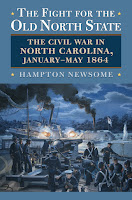
"Hampton Newsome's recommended book tells the chain of events - the highs and lows, the bumbling and the courageous, from January to May, 1864 in the Old North State. It's all here."
The August issue of Civil War News (subscription) has a nice review by Joan Wenner of The Fight for the Old North State. As noted in the review, Wenner lives in eastern North Carolina and has visited many of the places discussed in the book.Friday, July 19, 2019
New Book Review in Civil War News: The Fight for the Old North State
Wednesday, July 10, 2019
Summer Sale: The Fight for the Old North State
Until July 31, you can get The Fight for the Old North State directly from
University Press of Kansas for $24.12 (31% off and free shipping). Use code SUMM31 at checkout.
"In The Fight for the Old North State, Newsome certainly adds to his reputation as an indefatigable researcher. Text, notes, and bibliography indicate both extensive original manuscript research as well as thoughtful synthesis of the available secondary literature. Readers appreciative of the high-level research and narrative interpretation skills displayed in Newsome's earlier military study Richmond Must Fall will find the same qualities here." - Civil War Books and Authors
Thursday, July 4, 2019
Random Thoughts on History Blog Looks at The Fight for the Old North State
Some great comments on The Fight for the Old North State from Tim Talbott at the Random Thoughts on History blog. As many of you know, I'm a big fan of Talbott's site - so I was happy to send along a copy. He reads many interesting titles and prepares thoughtful write-ups about them. I've also enjoyed chatting with him about the Petersburg Campaign. You can read his full post about my book at his site but I've included an excerpt below:
"Meticulously researched, vividly told and interpreted, The Fight for the Old North State not only helped fill a void in my own knowledge, it will certainly become the go to source for the greater Civil War community to understand these particular actions. In addition to a nice set of maps, the book also contains a number of photographs that help the reader with some of the campaign's lesser known figures. Do yourself a favor and add The Fight for the Old North State to your library. I highly recommend it." - Tim Talbott at the Random Thoughts on History
![]() |
| Tim Talbott |
"Meticulously researched, vividly told and interpreted, The Fight for the Old North State not only helped fill a void in my own knowledge, it will certainly become the go to source for the greater Civil War community to understand these particular actions. In addition to a nice set of maps, the book also contains a number of photographs that help the reader with some of the campaign's lesser known figures. Do yourself a favor and add The Fight for the Old North State to your library. I highly recommend it." - Tim Talbott at the Random Thoughts on History
Tuesday, June 18, 2019
First Review of The Fight for the Old North State
The first review of the The Fight for the Old North State is out - a highly
favorable, thorough, and thoughtful appraisal from Drew Wagenhoffer over at Civil War Books and Authors.Review Excerpt
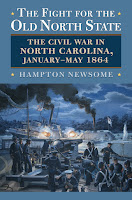
"Readers appreciative of the high-level research and narrative interpretation skills displayed in Newsome's earlier military study Richmond Must Fall will find the same qualities here . . . In a narrative that details battlefield events and analyzes their military, political, and social contexts in equal measure, The Fight for the Old North State is an excellent history of an understudied late-war offensive that was a rare (though qualified) Confederate success. While racial and political violence were certainly not new to 1864, Newsome's account of the campaign also usefully portrays it as a clear, early demonstration that the coming year's increasingly frequent confrontations between the most volatile combinations of battlefield combatants would be characterized by rising levels of lethal violence. Highly recommended." - Civil War Books and Authors
Saturday, June 1, 2019
Grant's North Carolina Raid
In January 1864, Ulysses S. Grant proposed a large raid into North Carolina, one that would start from Suffolk, Virginia, move on Raleigh, and then draw on the Union base at New Bern for operations against Wilmington.
Though eventually rejected by officials in Washington, the plan (reproduced below) reflected the large-scale raiding strategy Grant and Sherman would employ elsewhere in the last few years at the war - for example, during the Meridian Campaign, as part of the March to the Sea, and at the end of the Petersburg Campaign. The proposal also demonstrated Grant's awareness of the importance slaves held for the Confederate war effort and the demoralizing impact these operations would have on North Carolina soldiers then serving in Virginia and elsewhere.
Maj. Gen. H. W. Halleck,
[O.R.A. 33:394-395]
Chapter 4 of of The Fight for the Old North State goes into detail about Grant's proposal, which, by coincidence, was prepared only days before the Confederates
attacked New Bern, initiating their own offensive in the state.
Maj. Gen. H. W. Halleck,
General-in- Chief of the Army, Washington, D. C.:
General:
I would respectfully suggest whether an abandonment of all previously
attempted lines to Richmond is not advisable, and in lieu of these one
be taken farther south. I would suggest Raleigh, N. C, as the objective
point and Suffolk as the starting point. Raleigh once secured, I would
make New Berne the base of supplies until Wilmington is secured.
A moving force of 60,000
men would probably be required to start on such an expedition. This
force would not have to be increased unless Lee should
withdraw from his present position. In that case the necessity for so
large a force on the Potomac would not exist. A force moving from
Suffolk would destroy first all the roads about Weldon, or even as far
north as Hicksford. From Weldon to Raleigh they would scarcely meet with
serious opposition. Once there, the most interior line of railway still
left to the enemy, in fact the only one they would then have, would be
so threatened as to force him to use a large portion of his army in
guarding it.
This would virtually force an evacuation of Virginia and
indirectly of East Tennessee. It would throw our armies into new fields,
where they could partially live upon the country and would reduce the
stores of the enemy. It would cause thousands of the North Carolina
troops to desert and return to their homes.
It would give us possession of many negroes who are now indirectly aiding the rebellion. It would draw the enemy from campaigns of their own choosing, and for which they are prepared, to new lines of operations never expected to become necessary. It would effectually blockade Wilmington, the port now of more value to the enemy than all the balance of their sea-coast. It would enable operations to commence at once by removing the war to a more southern climate, instead of months of inactivity in winter quarters. Other advantages might be cited which would be likely to grow out of this plan, but these are enough.
From your better opportunities of studying the country and the armies that would be involved in this plan, you will be better able to judge of the practicability of it than I possibly can. I have written this in accordance with what I understand to be an invitation from you to express my views about military operations, and not to insist that any plan of mine should be carried out. Whatever course is agreed upon, I shall always believe is at least intended for the best, and until fully tested will hope to have it prove so.
I am, general, very respectfully, your obedient servant,![]() |
It would give us possession of many negroes who are now indirectly aiding the rebellion. It would draw the enemy from campaigns of their own choosing, and for which they are prepared, to new lines of operations never expected to become necessary. It would effectually blockade Wilmington, the port now of more value to the enemy than all the balance of their sea-coast. It would enable operations to commence at once by removing the war to a more southern climate, instead of months of inactivity in winter quarters. Other advantages might be cited which would be likely to grow out of this plan, but these are enough.
From your better opportunities of studying the country and the armies that would be involved in this plan, you will be better able to judge of the practicability of it than I possibly can. I have written this in accordance with what I understand to be an invitation from you to express my views about military operations, and not to insist that any plan of mine should be carried out. Whatever course is agreed upon, I shall always believe is at least intended for the best, and until fully tested will hope to have it prove so.
U. S. GRANT,
Major- General[O.R.A. 33:394-395]
Subscribe to:
Posts (Atom)
SPEAKING SCHEDULE
Looking forward to more talks coming up. Here is the current schedule: May 6, 2026 - Brunswick, NC CWRT May 27, 2026 - Fredericksburg C...
-
In gathering research for a new project, I've been poring over Confederate and Union maps of Richmond's Civil War fortifications. J...
-
Waud, "Battle of Darby Town Rd. Gen'l Butler & his staff," Library of Congress Here's a look at an eyewitness s...
-
In 2003, I drew this sketch after a visit to Bandy Field , a small nature park in Richmond, Va. several blocks from my parents' home. ...